Showing posts with label Explorer. Show all posts

Saturday, 18 April 2009

Old timers

Two women from different generations who shared a passion for Vietnamese folk music joined forces to open the Ca Tru Thang Long Theatre.

Ca tru is an ancient form of chamber music – normally featuring a female vocalist, percussionists and a lute-player – that originated in northern Vietnam as a form of entertainment for the royal court nearly 1,000 years ago.

As with many of Vietnam’s most precious traditional arts, it has experienced some lean times in the latter half of the 20th century but in recent years there have been extensive efforts to re-invigorate the genre. The latest champion of the cause is the Ca Tru Thang Long Theatre on Tong Dan street in Hanoi, which is the result of a collaboration between the Museum of Vietnam Revolution, where it is located, and Nguyen Lai Trading company.

Rather than simply providing a space where revivalists can play to limited number of purists, the theatre is also partly an exhibition space where audiences can find out more about this traditional form of music with a display of pictures, photos and other items. In the showroom you can also find silk from Van Phuc village, ceramics from Bat Trang village and lacquer decorative items from Ha Thai village.

“My theatre is the first in Vietnam to organise professional ca tru shows. The theatre is well appointed with modern sound system and lighting,” says Nguyen Lan Huong, the 28-year-old director of Ca Tru Thang Long Theatre. After years studying the traditional arts, Huong was impressed by the efforts being made to restore ca tru by clubs in the provinces of Ha Tinh, Thanh Hoa, Hung Yen, Bac Ninh, Thai Binh and Haiphong as well as Hanoi and Ho Chi Minh City.

“But performances were not as regular and professional as other traditional folk genres or performance arts such as cheo, tuong or cai luong,” says Huong. “I dreamed of a special theatre for ca tru ever since I was lucky enough to meet the singer Bach Van and now my dream has come true!” An experienced ca tru singer, Bach Van is now the art director of the theatre and is delighted to be able to share her passion for ca tru with younger generations.

“At present, our theatre has 15 young and talented performers. We have also received great assistance from musicologists, cultural experts and old ca tru artists, who are now over 80 years old but their voices and performances are still perfect!” says Bach Van.

“We can recreate the true essence of ca tru with its beautiful rhythms and poetry without having a young lady serving liquor to customers like in the past!” she adds, alluding to ca tru’s reputation as a geisha-like form of entertainment in the 20th century. “We aim to both preserve and develop ca tru as well as build a better society,” adds Lan Huong. “Part of the theatre’s profits is for training potential ca tru artists.

But we will also provide funds for orphans and children from disadvantaged backgrounds to attend vocational training centres so that they can find a good job and contribute to society.” The theatre’s MC, Van Anh is hopeful that the theatre will attract a young audience.

“Ca tru music sounds strange to the uninitiated. Clicks and clacks accompany centuries-old ballads,” says Van Anh, who learnt how to sing and play ca tru tunes as a young girl in Haiphong. “It is not the kind of music that inspires toe tapping or humming. But it can transport you to anotJustify Fullher age, once you start to recognise the art’s fine subtleties.

It can be really intoxicating.” The theatre seats 100 people for each performance. There are three 45-minute shows with 10 different dances and songs daily at 4.45pm, 6pm and 7.15pm. Tickets cost VND35,000 per person.

The origins of ca tru

The origins of ca tru are still the subject of debate. One story goes that a woman named A Dao created the genre, when lulling the enemy into a false sense of security with her sweet singing (ca tru is also sometimes referred to as Hat A Dao).

Another theory is that a woman named Dao Thi, a talented musician beloved by the Ly Dynasty (1009 – 1225), introduced an embryonic form of ca tru music to the imperial court, influenced no doubt by Chinese taste in music. By the 15th century it had become a hobby for aristocrats and scholars and performances could be heard at communal halls, inns and private homes throughout the land.

During a ca tru performance, the musicians – collectively known as giao phuong – stay seated. The singer, always a woman, is called a co dao and she will also play the phach – short drumsticks played off a small block of bamboo. A musician accompanies the singer on the dan day, a long-necked three-stringed lute with 10 frets.

There will also be a drummer, playing a small drum known as the Trong Chau. However by the 19th century ca tru had become a geisha-style form of entertainment. Attractive young female singers would entertain men in a relaxed environment, sometimes serving drinks, snacks and possibly opium.

As a result of these sordid associations after the August Revolution of 1945, ca tru was suppressed as it had come to represent the maltreatment of women for the entertainment of ruling class men. Ca tru quickly faded into obscurity and arguably as an art form it has never truly recovered.

VietNamNet

Friday, 17 April 2009

In pictures: Hanoi's yellow spring

In pictures: Hanoi's yellow spring


Monday, 13 April 2009

Capital Transfering Edict in ceramics on show

A big ceramic Edict in the Transfer of the Capital has been placed at Do Temple ( Bac Ninh Province) in celebration of Thang Long Great Anniversary. The Edict, which is 3.5 metres high and 8 metres wide, is made of 214 ceramic pieces of Chinese characters.


The main part of the scroll is Ly Thai To's edict to transfer the capital of Dai Co Viet from Hoa Lu (Ninh Binh Province) to Dai La (then renamed Thang Long). The edict consists of 214 characters in correspondence with 214-year reign of the Ly dynasty.

The entire 214 characters are made from Bat Trang ceramics attached to an area of 6 square metres, each of which is 16x16 wide. These characters were written by the Han Nom Huong Lan and made by Pham Xuan Hoa, a Bat Trang craftsman.


In pictures: Lily flowers whiten Hanoi streets

Pictures of lily flowers in Hanoi


Thursday, 9 April 2009

36 hours in Hanoi

The New York Times

By NAOMI LINDT
Published: April 5, 2009

Bowls of bun bo nam bo, grilled strips of beef served over rice noodles, at a Hanoi street stall.

NEAR Hoan Kiem Lake in the heart of Hanoi, a digital clock counts down the seconds to this atmospheric city's 1,000th birthday in 2010. There certainly will be a lot to celebrate: the city, Vietnam's capital, has experienced extraordinary growth over the last two decades, evolving from a grim, famine-ravaged place into a sophisticated metropolis with high-rises, sensational cuisine and world-class art. Those shaking their heads at the disappearance of local culture, though, should think twice. For every glitzy mall, there's an incense-filled temple nearby, and cultural influences of the past are still part of the modern-day fabric, from revered Confucian monuments to trendy French restaurants. In fact, it's this zeal for barreling toward the future while always looking back that defines this city.

Friday

5 p.m.
1) IMBIBING EARLY

In a country that's up before dawn and closes down around 9 p.m., it's by necessity that Vietnamese nightlife kicks off early. Bia hoi, a type of local draft beer, is also the name for the outdoor cafes that serve it at rock-bottom prices, forming the center of the city's raucous drinking culture. The intersection of Ta Hien and Luong Ngoc Quyen Streets in the bustling Old Quarter is called “bia hoi corner” for its no-frills beer vendors. Backpackers, students and middle-age men in post-workout mode cram onto sidewalk seating for drafts directly from a keg (3,000 dong, about 17 cents at 18,000 dong to the dollar).

7 p.m.
2) A FISHERMAN'S FEAST

Hai San Ngon (199A Nghi Tam Street; 84-4-37-19-31-69), which translates as "tasty seafood," is a restaurant that lives up to its name. The large menu offers an excellent selection of steamed, sautéed and grilled options for countless crustaceans and fish. Standouts include the blood cockles salad (50,000 dong), clams mixed with shredded carrots, cucumbers and green papaya; and sautéed prawns in a sweet, hot tamarind sauce (80,000 dong). Dine on the large outdoor terrace flanked by elegant, slate-tiled pools or in one of the glassed-in dining rooms where chandeliers fashioned from authentic bamboo fishing cages dangle overhead.

9:15 p.m.
3) WATER WORLD

For a family-friendly treat, head to the Thang Long Water Puppet Theater (57B Dinh Tien Hoang Street; 84-4-38-25-54-50; www.thanglongwaterpuppet.org; admission 40,000 to 60,000 dong), where 1,000-year-old stories invented by farmers during the Red River's rainy season are recreated several times a day. Puppeteers, hidden backstage and standing thigh-high in a pool of water that extends onto the stage, expertly maneuver long sticks to make lacquered wooden marionettes skip, splash and frolic across a shallow pool. Puppets are given voice by singers as musicians play traditional instruments.

Saturday

9:30 a.m.
4) LUCKY TURTLES

For over 1,000 years, the Chinese ruled northern Vietnam, and their influence is evident in the defining role that Confucianism still plays in society. The Temple of Literature, or Van Mieu (at Quoc Tu Giam and Van Mieu Streets; admission 5,000 dong), was built in 1070 to honor Confucius and became the country's first university. The vast complex of peaceful courtyards, lotus-filled pools and red-roofed temples is still an essential pilgrimage for many. The rows of stone tortoises lining the grounds bear steles with the names of former students; young men and women preparing for exams still rub the turtles' heads for good luck.

11:30 a.m.
5) STREET STALL SMARTS

If you're willing to forgo air-conditioning and proper chairs, you'll discover the sublime flavors cooked up in Hanoi's street stalls, which are known by their addresses and the dishes they serve. Generally, you'll find the freshest and finest fare at the most crowded stalls, with prices of roughly 20,000 to 50,000 dong. Don't-miss items include banh cuon, soft rice crepes filled with minced pork and mushrooms at 14 Hang Ga Street; bun cha, grilled pork patties served with crispy crab spring rolls and fresh herbs at 1 Hang Manh Street; and bun bo nam bo, grilled strips of beef served over rice noodles, fresh herbs and peanuts at 67 Hang Dieu Street.

1:30 p.m.
6) CREATIVE HAVEN

It's an ideal time to score some deals on Vietnamese art, which has been gaining international recognition. An essential first stop for painting and sculpture is the Art Vietnam Gallery (7 Nguyen Khac Nhu Street; 84-4-39-27-23-49; www.artvietnamgallery.com), run by Suzanne Lecht, an American who has been involved in the local art scene for 15 years. Other venues like the Mai Gallery (113 Hang Bong Street; 84-4-39-38-05-68; www.maigallery-vietnam.com), the Apricot Gallery (40B Hang Bong Street; 84-4-38-28-89-65; www.apricot-artvietnam.com) and the Dragon Gallery (12 To Tich Street; 84-4-38-25-07-40) represent dozens of artists, though they seemingly lack any specific curatorial direction.

5 p.m.
7) ISLAND RETREAT

Hanoi's buzz can be as exhausting as it is intoxicating, so head to the Sunset Bar at the InterContinental Hanoi Westlake (1A Nghi Tam Street; 84-4-62-70-88-88; www.ichotelsgroup.com) for a tranquil cocktail. Built on an artificial island overlooking West Lake, a 15-minute drive from the town center, the stunning bar's wooden deck features woven rattan couches and plush daybeds topped with triangular pillows, making it a favorite late afternoon hangout for diplomats and designers alike. With the breeze in your hair and a martini in hand, you'll feel as if you've been whisked away to an exotic, tropical resort far from the city.

7:30 p.m.
8) FRENCH TASTE

From local households to five-star restaurants, Hanoi is a city of superb cooks. A promising newcomer to the scene is La Badiane (10 Nam Ngu Street; 84-4-39-42-45-09), where the Asian-inspired French cuisine that emerges from the kitchen is the work of Benjamin Rascalou, an acclaimed local chef. The restaurant is housed in an old, white-shuttered colonial villa with hand-painted silk chandeliers, earth-toned décor and intimate individual dining rooms. Three-course set menus (from $23; dollars are commonly quoted at high-end Hanoi hotels and restaurants, though payment is in dong) include options like shrimp ravioli in peanut sauce, aubergine mille-feuille and coffee-marinated lamb.

11 p.m.
9) DODGING THE LAW

Thanks to the government's regular crackdowns on what if refers to as "social evils," finding a spot that's fun for a late-night drink can be challenging. To thwart the authorities, many bars will simply shutter their front entrances around 11 p.m. or midnight, but in speakeasy fashion, keep the party going. Le Pub (25 Hang Be Street; 84-4-39-26-21-04; www.lepub.org) is a friendly Old Quarter bar with drink specials and a great iTunes library as its soundtrack. Eté (95 Giang Van Minh Street; 84-4-9-76-75-13-31) lures a diverse expat crowd for its labor-intensive fresh fruit cocktails, tasty pub food and impromptu dance parties. On weekends, D.J.'s create a bumping scene at Loop (6 Hang Bai Street; 84-4-62-70-05-95), a small dance club just south of Hoan Kiem Lake.

2 a.m.
10) WHOLESALE GOODNESS

The Vietnamese are renowned for their industriousness, an attribute nowhere more apparent than at the city's nocturnal markets. Around 1 a.m., the Long Bien Market (Dyke Road, next to Long Bien Bridge) is just getting started; for the next few hours, it's positively throbbing with activity. Along the dimly lighted aisles, you'll see seas of green-skinned oranges, baskets overflowing with hot-pink dragon fruit and trucks stacked to the brim with watermelons. Just a few miles down the road is the fragrant, colorful Quang Ba flower market, where huge bouquets of red roses and armloads of pink gladiolas are sold for less than 50,000 dong. It's all packed up and gone by 5:30 or 6 a.m.

Sunday

11 a.m.
11) FASHIONISTA FANTASY

With talented seamstresses and cheap materials, Vietnam is a fashion maven's paradise. In a strikingly white three-story building on a street known for its silk shops, the new Tan My Design (61 Hang Gai Street; 84-4-39-38-11-54; www.tanmyembroidery.com.vn) shows off the work of talented local designers. Like true Hanoians, they've taken styles of the past — mandarin collars, sumptuous silks and fine embroidery — and given them a new lease on life, perfectly suited for the 21st century.

THE BASICS

There are no direct flights between Hanoi and New York, but several carriers, including Cathay Pacific, Korean Air and American Airlines, connect the two cities with stopovers in Hong Kong, Seoul or Tokyo. A recent online search found round-trip one-stops for late April starting around $1,180. A taxi from Noi Bai Airport into the city center costs roughly 230,000 dong, about $13 at 18,000 dong to the dollar. Taxis are widely available in the city.

At the InterContinental Hanoi Westlake (1A Nghi Tam; 888-424-6835 in the United States; www.ichotelsgroup.com; rooms from $128.), the city's newest luxury hotel, has several buildings built right over the water, connected by lantern-lighted walkways.

More central is the Maison D'Hanoi Hanova Hotel (35-37 Hang Trong Street; 84-4-39-38-09-99; www.hanovahotel.com; rooms from $80), a boutique hotel a few minutes' walk from Hoan Kiem Lake. Its 55 rooms feature wood floors, padded silk headboards and thick white duvets.

Source: http://travel.nytimes.com/2009/04/05/travel/05hours.html

Wednesday, 8 April 2009

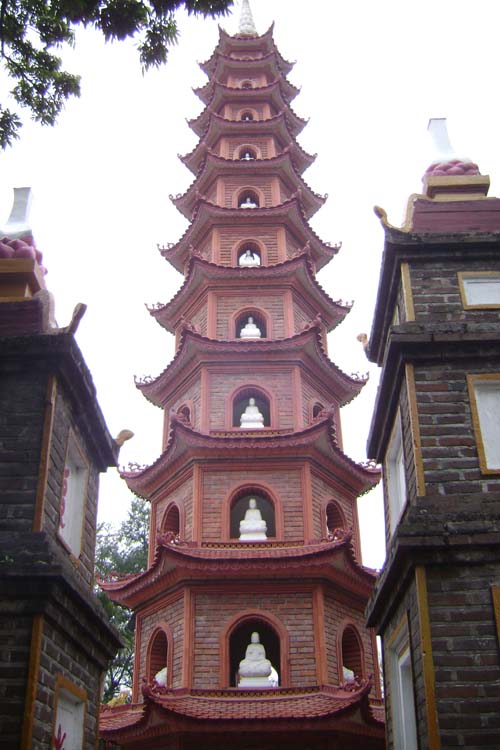
Tran Quoc - the oldest Buddhist temple in Hanoi

Tran Quoc Temple, which was built 14 centuries ago and has undergone many renovations, is an important site in the West Lake scenic complex.

(picture: the tallest pagoda at Tran Quoc Temple)

Buddhism was transmitted into Vietnam by Indian monks and nuns and merchants in the early comon era. Since then many Buddhist temples have been built, in which Tran Quoc Temple is the first to be constructed.

This Buddhist temple was built in the 6th century, under the King Ly Nam De's reign, near the Red River and was first named Khai Quoc (Establishing the Nation). In the 15th centuty, the temple was renamed An Quoc (Peaceful Nation). In the early 17th century, the temple was moved to Gold Fish islet in the West Lake due to the erosion of the river bank and has been standing there till present. Under King Le Hy Tong (1675-1705), the temple was renamed Tran Quoc (Protecting the Nation).

The temple was renovated in 1624 and 1628. In 1639, the temple was expanded with more space for worship and meditation halls.

In 1815, the temple was once renovated, bells were cast and more beautiful Buddhas were put up. In a stele at the temple, Dr Pham Quy Thich wrote: "The Buddhist worship hall, incense offering hall and the front hall are built first. Then comes the two corridors, bell tower and rear hall. All of them are bigger. Buddhas and giant bells are also cast at the same time."

In 1832, emperor Minh Mang paid a visit to Tran Quoc TeAdd Imagemple and granted silver for renovations.

Tran Quoc temple has a unique layout, different from other Buddhist temples. The front is the worship hall and then comes the rear palace. The back is the two corridors and the bell tower. There are many beautiful Buddhas in the temple, especially the laying Shakyamuni Buddha.

The temple is ranked fourth in the most beautiful Buddhist temples of Vietnam.

Thursday, 2 April 2009

In pictures: Hanoi spring

The onset of spring with drizzles and new buds bursting make Hanoi more lively than ever. The boat on the Red River, the buds of the tropical almond trees, the snow white of legume blossoms all make an attractive picture typical of Hanoi.


Hanoian
nguoihanoi.com.vn

Thousand year Thang Long and Hanoi plants

Thang Long-Hanoi is grouped as one of the oldest capitals in the world. Since An Duong Vuong established the capital here until present, Hanoi has been undergoing 24 centuries of history. The most important landmark is when Ly Thai To moved the capital from Hoa Lu to Dai La and renamed it Thang Long (Ascending Dragon).

After 10 centuries of development, many castles, citadel, royal gardens have been constructed. This is the convergent place of various plants from the river delta, which evolved from the local and Chinese wild plants and the cereal plants.

As a the capital, Thang Long became a complete city with big and small gates leading to bustling markets from the central citadel. There are a variety of weird plants and flowers collected from across Vietnam and neighbouring countries in the Imperial City and the Forbidden City.

In 1882, the French invaded Hanoi (Thang Long's name given by emperor Minh Mang). They destroyed the city of Thang Long and rebuilt Hanoi in the Western style. In planning Hanoi as the capital of French Indochina, the French renovated the Sword Lake surroundings based on manufacturing and trading streets like Hang Bong, Hang Dao, Hang Trong, Hang Gai, Hang Thung, Hang Thiec. They then constructed the Western quarter around the West Lake.

The then urban planners selected trees from Vietnam's tropical forests as shade trees for square streets. At the same time, they imported common plants in South-East Asia such as the tropical almond tree and many beautiful species of flowers from Africa and South America to decorate Hanoi streets. These plants has now become the symbols of many streets and residence areas.

Besides the authority set up the Botanical Garden as a place to cultivate and collect plants from across the country and other continents and the popularised these plants in many parts of the country. The number of plants in Hanoi was increasingly diverse. Many green areas in the city play the roles as lungs balancing the ecology in densely populated areas.

After the capital Hanoi was liberated in 1954, Hanoi residents began building up a new peaceful life. Trees were planted in many new areas in the city. The striking landmark is the construction of Thong Nhat Park, renovation of Co Ngu Street (now Thanh Nien Street) dividing two large lakes. Those days seen the tireless work Hanoi residents, especially students. Many new parks and green areas were also built.

During the American War, Hanoi was always covered with green trees and beautiful flowers despite American destruction. Trees were still increasingly planted along many streets.

An important event in the last years of the American War is the construction of President Ho Chi Minh's Mausoleum. At this time, plants from across the north are brought here to decorate the Ba Dinh Historical Vestiges. There were so many plants and flowers that it was decided to set up a management board of trees. Later when the south was liberated, the number of trees increased, which makes Ho Chi Minh's Mausoleum really a botanical garden.

In the new are of economic development and international integration, various plants have been imported to enrich Hanoi's flora.

The expansion of Hanoi (now including Ha Tay province, Me Linh district) makes this flora even more diverse. The statistics of trees in greater Hanoi would be a great scientific work.

In the occastion of the Great Anniverary of Thang Long, it is a must to produce detailed statistics of Hanoi flora. A book on Thang Long-Hanoi plants will be a great contribution to celebrating the thousand-year capital.


Sunday, 29 March 2009

Enjoying hat xam at Dong Xuan Market

Today's youth do not seem to be fascinated by melodies of traditional music and theatre. They even turn their back on those genres. So what do you and I, the young, think when the national traditions and identity are being forgotten, are dying out?

As usual at 7 in the evening, audience of Hanoi come to Dong Xuan Market to enjoy hat xam performances by artists of the Centre for the Development of Vietnamese Music. Although this programme has just begun for a short time, it attracts a lot of Hanoians. This is also an opportunity to introduce traditional music of Vietnam to tourists, both domestic and foreign.

At first, many people came here out of curiosity. They were surprised to see those who wore dark clothes, black glasses and conical hats in this bustling city. The artists were passionately deep in the beautiful melodies of xam, quan ho or trong quan. They were surprised to hear clear and pleasant sounds amid terrible noise from the streets.

Since the time when they saw it as "strange", they gradually became faithful audience every Saturday night. Lan Anh, from National Economic University, said "I only know about xam and chau van from books and newspapers. I haven't attended any performance before. Now I find this type very pleasant to hear."

Traditional music is considered the soul of Vietnam. Ms Do Thi Nuong, at Hang Than Street, said "I have been listening to xam since I was a child but listening just to listen. Now I can understand every word of xam. I come here almost every week."

It seems when people are too busy earning their living, bored with noisy sounds, they want to return to the past with attractive, beautiful melodies.

Besides Vietnamese, who want to seek the homeland soul, xam also attracts many foreigners. American Fred Thurner was listening excitedly and taking photos of the artists. He said "Your music attracts me."

Not many knows that enthusiatic artists must make great efforts to organise a performance every week. They are trying to restore old melodies likely to be lost if not conserved.

Do the present 8x, 9x generations seem to young to enjoy the so-called "old music"? But the impossible is now appearing in the centre of Hanoi. Hope xam will attract more audience in the near future.

Saturday, 28 March 2009

Barringtonia flowers in full blossom beside Sword Lake

Cold combined with spring rain makes Hanoi so attractive at this time. Perhaps this is the first year in recent decades that Hanoi weather is so beautiful, leaves falling during spring, flowers colouring the streets. The Sword Lake becomes so romantic in the red of barringtonia blossoms.


Photos by Quach Trung